

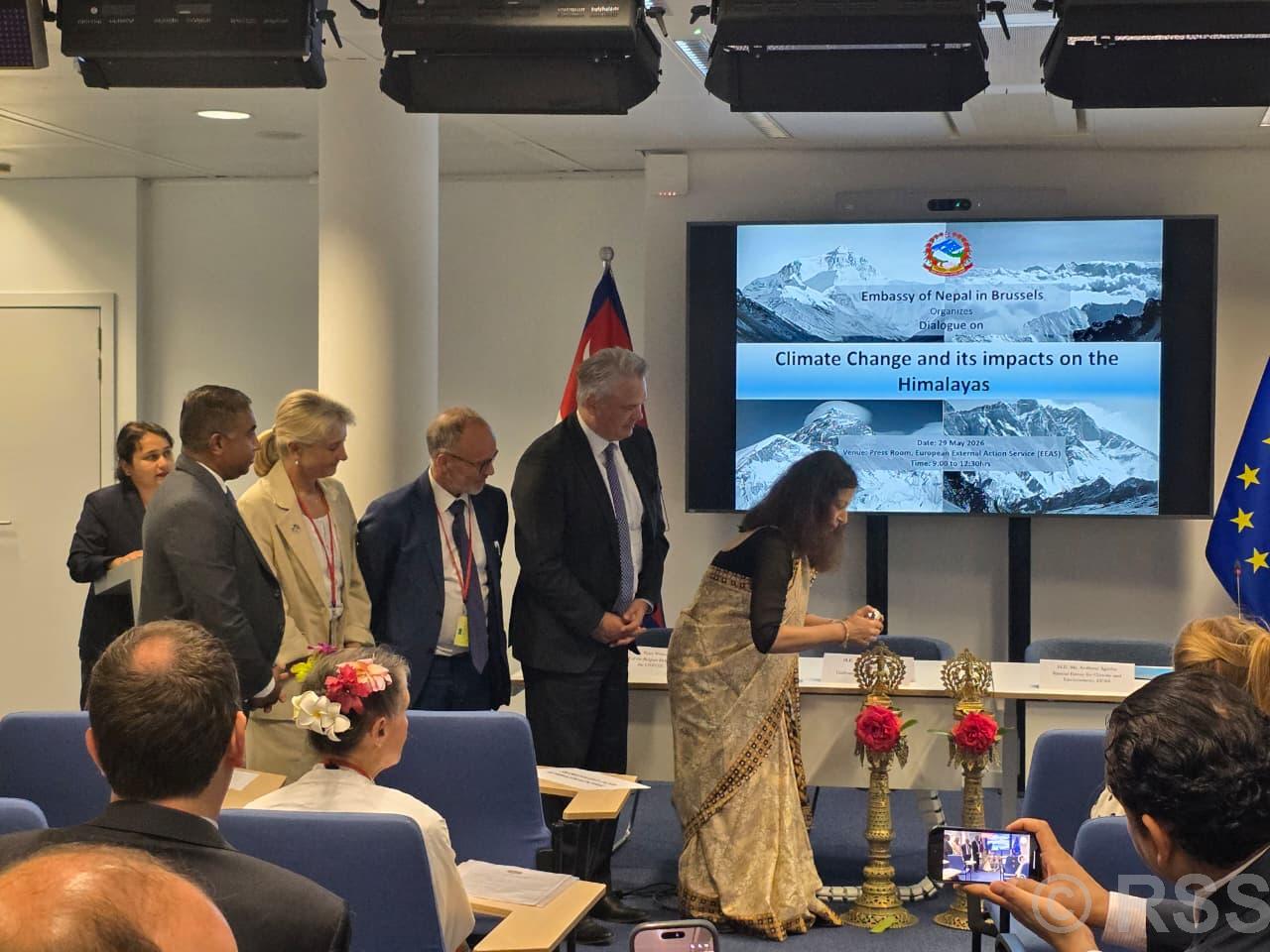
A Himalayan climate dialogue Brussels event brought diplomats, scientists, and international officials together in Belgium to discuss the growing impact of climate change on the Himalayan region and the urgent need for stronger global cooperation and financing.
The event, titled “Dialogue on Climate Change and its Impact on the Himalayas,” was organised by the Embassy of Nepal in Brussels at the European External Action Service (EEAS). It was held on Friday to mark International Everest Day, which commemorates the first successful ascent of Mount Everest and highlights the global significance of mountain ecosystems.
According to the embassy, the dialogue focused on the environmental challenges facing mountain countries like Nepal. These include rising temperatures, melting glaciers, changing rainfall patterns, and increasing risks of floods and landslides that threaten communities living in fragile mountain regions.
The programme brought together a wide range of participants, including ambassadors, heads of mission, diplomats based in Belgium, senior officials from Nepal, Belgium, and the European Union, as well as climate scientists, academics, students, and representatives from international organisations and civil society groups.
During the event, a video message from Nepal’s Minister for Foreign Affairs, Shisir Khanal, was presented. In his remarks, he highlighted the shared global responsibility to protect mountain ecosystems, which are among the most vulnerable to climate change. He reaffirmed Nepal’s commitment to leading efforts in climate adaptation and environmental protection.
A second video presentation showcased the impact of climate change in the Himalayas. It illustrated how rising temperatures are affecting glaciers, water resources, agriculture, and biodiversity across the region. The presentation supported the central theme of the dialogue, which called for stronger global cooperation.
Nepal’s Ambassador to the Benelux countries and Head of Mission to the European Union, Sewa Lamsal, welcomed participants and extended greetings on both International Sagarmatha Day and Nepal’s Republic Day. She outlined key climate challenges facing Nepal and stressed the importance of international support for adaptation efforts.
She also highlighted the need for substantial financial investment to implement Nepal’s National Adaptation Plan. According to her remarks, global climate finance must become more accessible, efficient, and aligned with the needs of vulnerable countries.
A major point raised during the dialogue was the issue of climate finance. Maheshwar Dhakal, Head of the Climate Change Management Division at Nepal’s Ministry of Agriculture, Forest and Environment, delivered a keynote speech focusing on financing resilient development in Nepal.
He noted that Nepal is already taking domestic action through community-based adaptation projects, renewable energy expansion, forest conservation, and national climate commitments. However, he also pointed to structural challenges in global climate finance, including high transaction costs, limited access, and capacity gaps that prevent developing countries from receiving adequate support.
European Union representatives also expressed support for stronger cooperation. Anthony Agotha, Special Envoy for Climate and Environment at the EEAS, praised Nepal’s diplomatic efforts in raising awareness of climate vulnerability and reaffirmed the EU’s role as a partner for countries on the frontlines of climate change.
Belgian officials echoed similar concerns. Peter Wittoeck, Head of Belgium’s delegation to the UN climate process, highlighted the vulnerability of mountain ecosystems and stressed the importance of continued international cooperation to support Least Developed Countries facing climate risks.
From the United Nations, Camilla Bruckner, Director of UN Brussels, described the Himalayas as a critical global public good. She emphasised the need for a system-wide approach rather than isolated projects, calling for coordinated global climate action.
A video message from Dr. Pema Gyamtsho, Director General of the International Centre for Integrated Mountain Development (ICIMOD), also featured in the programme. He referred to the Hindu Kush Himalayas as the “third pole” of the world, underscoring their importance as a major source of freshwater for nearly two billion people across Asia.
He warned that climate change threatens these vital ecosystems and called for collective international action to protect them.
Dr. Prajal Pradhan, Associate Professor at the University of Groningen, presented scientific research on climate impacts and stressed the importance of balancing development with ecological limits. His presentation reinforced the need for sustainable policies that integrate environmental and social priorities.
The dialogue concluded with an open discussion session where participants exchanged ideas and explored possible areas of cooperation. Topics included climate adaptation strategies, financing mechanisms, and regional collaboration to address shared environmental risks.
The Himalayan climate dialogue Brussels highlighted growing international recognition of the Himalayas as a critical climate-sensitive region. It also reinforced calls for stronger financial support, scientific cooperation, and policy coordination to address the accelerating impacts of climate change on mountain ecosystems and the communities that depend on them.

