

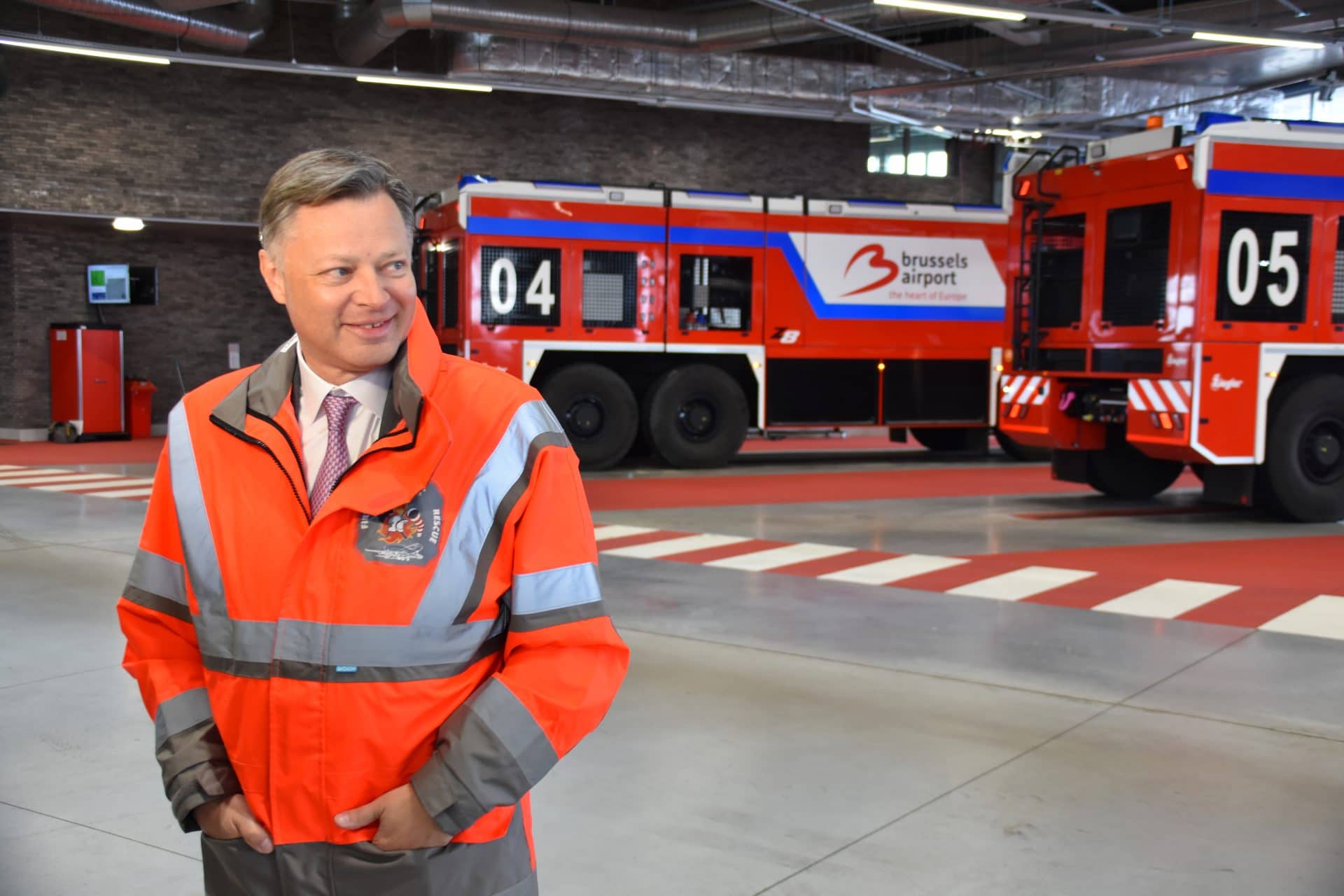
Brussels Airport has strengthened its emergency response capabilities by introducing four new specialized crash tenders to its airport fire service. The new vehicles replace five older units that had reached the end of their operational life and are designed to improve safety and response times across the airport.
The investment forms part of the airport’s ongoing efforts to maintain high safety standards and ensure rapid intervention during emergencies. The new crash tenders, manufactured by Rosenbauer, have been built specifically for airport operations and can respond quickly to incidents on the airfield.
Each vehicle weighs 39 tonnes and can reach speeds of up to 115 kilometers per hour. Their design allows firefighters to travel rapidly across the airport and reach emergency situations within strict response time requirements.
The crash tenders carry 12,500 liters of water, 1,500 liters of firefighting foam, and 225 kilograms of dry powder. This large capacity enables crews to tackle major incidents effectively while operating in demanding airport environments.
A key feature of the new vehicles is their roof-mounted water cannons. These systems can discharge up to 5,200 liters of water per minute, allowing firefighters to respond quickly to aircraft fires and other large-scale emergencies.
One of the newly introduced crash tenders includes a steel piercing nozzle system. The technology allows firefighting agents to be injected directly into an aircraft cabin or cargo hold. This capability can help crews combat fires more effectively by reaching areas that may otherwise be difficult to access during an emergency.
According to Brussels Airport, the new vehicles meet the highest safety requirements established by the International Civil Aviation Organization and the European Union Aviation Safety Agency. Compliance with these standards ensures the airport remains prepared for a wide range of aviation-related incidents.
The airport has also invested in firefighter training as part of the modernization program. Alongside the new emergency vehicles, Brussels Airport has introduced a driving simulator designed to prepare future operators for real-life situations.
The simulator features the same cab configuration as the new crash tenders, allowing firefighters to train in a realistic environment. Emergency crews can practice handling different scenarios while remaining in a safe and controlled setting. Airport officials believe the simulator will improve operational readiness and help firefighters develop essential skills before responding to actual incidents.
Together, the four crash tenders and the training simulator represent an investment of nearly €6 million. Airport leaders say the funding reflects a strong commitment to maintaining safety across airport operations.
Brussels Airport’s fire service currently employs 150 personnel. Teams work around the clock to ensure firefighters are available 24 hours a day, seven days a week. Their duties extend beyond aircraft-related emergencies and include responding to medical incidents, fire alarms, and preventive safety operations.
Firefighters are also placed on standby whenever an incoming aircraft reports a technical issue before landing. This precaution allows emergency crews to react immediately if assistance is required after touchdown.
Airport safety regulations require the fire service to reach incidents on the airfield within three minutes. At least three crash tenders must respond to such emergencies. To meet this target, Brussels Airport operates two fire stations positioned on opposite sides of the airport.
For incidents occurring inside airport facilities, including the passenger terminal, emergency teams must arrive within a maximum of five minutes. These strict response times are considered essential for protecting passengers, employees, aircraft, and airport infrastructure.
Following the arrival of the new vehicles, Brussels Airport’s fire service fleet now consists of approximately 25 specialized units. The fleet includes six crash tenders, aerial ladder vehicles, pumping appliances, an evacuation stair vehicle, and a firefighting robot designed to operate in hard-to-reach locations.
Airport officials say the expanded fleet and improved training resources will strengthen emergency preparedness and help ensure a rapid response to incidents both on the airfield and within airport facilities. The upgrades mark another step in Brussels Airport’s efforts to maintain high levels of operational safety while supporting growing aviation activity.

