

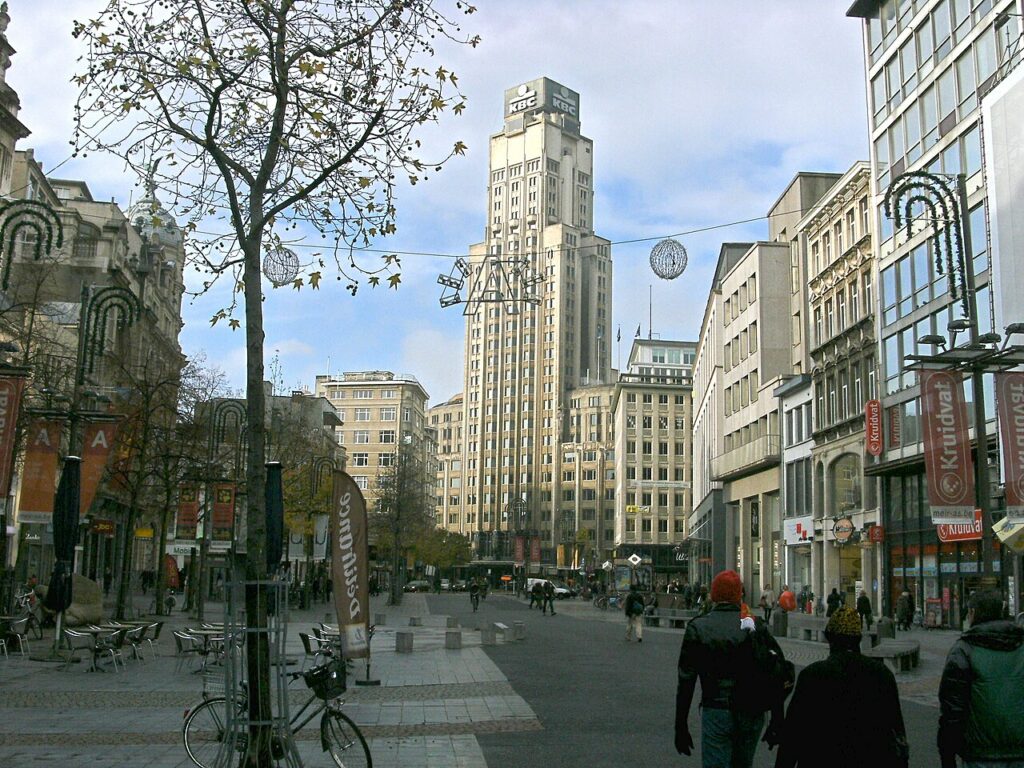
Antwerp is among the weakest cities in Europe for access to trees and parks, according to a new study that examined urban greenery in 862 European cities. The research found that only a small number of Antwerp residents live in areas that meet all recommended greenery standards.
The study measured cities using the “3-30-300 rule”, a guideline designed to improve urban living conditions. The rule says every home, school, and workplace should have a view of at least three trees, 30% tree cover in the local area, and a park within 300 metres.
Only 1% of people living in Antwerp meet all three conditions. The result places the Belgian city close to the bottom of the European ranking.
The greenery guideline was introduced in 2021 by Dutch urban forestry expert Cecil Konijnendijk. It has become a simple way to measure whether cities provide enough natural spaces for residents.
Antwerp was not the only Belgian city with a low score. Mechelen also performed poorly in the study. Brussels had a much stronger result and ranked in the upper half of the European cities included in the research.
Other Belgian cities, including Leuven, Liège, and Verviers, scored close to the European average. However, many other Belgian urban areas remained below the average level of access to trees and parks.
Across Europe, several major port cities performed better than Antwerp. Hamburg in Germany and Rotterdam in the Netherlands recorded stronger results despite also having large industrial areas and busy transport networks.
The study showed a clear difference between regions. Northern European cities generally had more green spaces than cities in southern Europe. Several eastern European capitals, including Warsaw, Bucharest, and Sofia, achieved some of the highest scores.
Researchers also found major differences within individual cities. Wealthier neighbourhoods often had more trees, parks, and green areas than lower-income communities. This suggests that access to nature is also linked to social and economic conditions.
Only two cities among the more than 800 locations studied had more than half of their residents meeting all three parts of the greenery rule. These cities were Varese in northern Italy and Espoo in Finland.
The results for Antwerp may not show the complete picture of every neighbourhood. It remains unclear whether the city’s large port area was included in the calculations. If it was included, the industrial land could have reduced the city’s overall score.
Individual residential areas may therefore have more greenery than the final ranking suggests. However, the study still highlights the need for more trees and accessible parks in many parts of Antwerp.
The city has already introduced several plans to increase urban greenery. Antwerp previously received recognition from the European Arboricultural Council for its long-term tree strategy.
The strategy focuses on planting trees that can survive for more than 100 years. These trees are expected to develop strong roots, provide shade, and improve the city environment over time.
City officials said the 3-30-300 rule is included in Antwerp’s government plans and plays an important role in future green policies. The city has been working to expand tree coverage and create more natural areas for residents.
Officials reported that Antwerp planted 3,057 new trees over three years. The total number of trees in the city has now reached 64,494. The city also plans to add hundreds of hectares of green space by 2030.
Urban experts say trees and parks can improve city life in many ways. Green areas can help reduce heat during warmer months, support cleaner air, and create healthier spaces for residents.
As European cities continue to face climate challenges, access to nature is becoming a bigger part of urban planning. Antwerp’s low ranking shows the challenges ahead, but ongoing tree projects could help improve the city’s future green landscape.

