

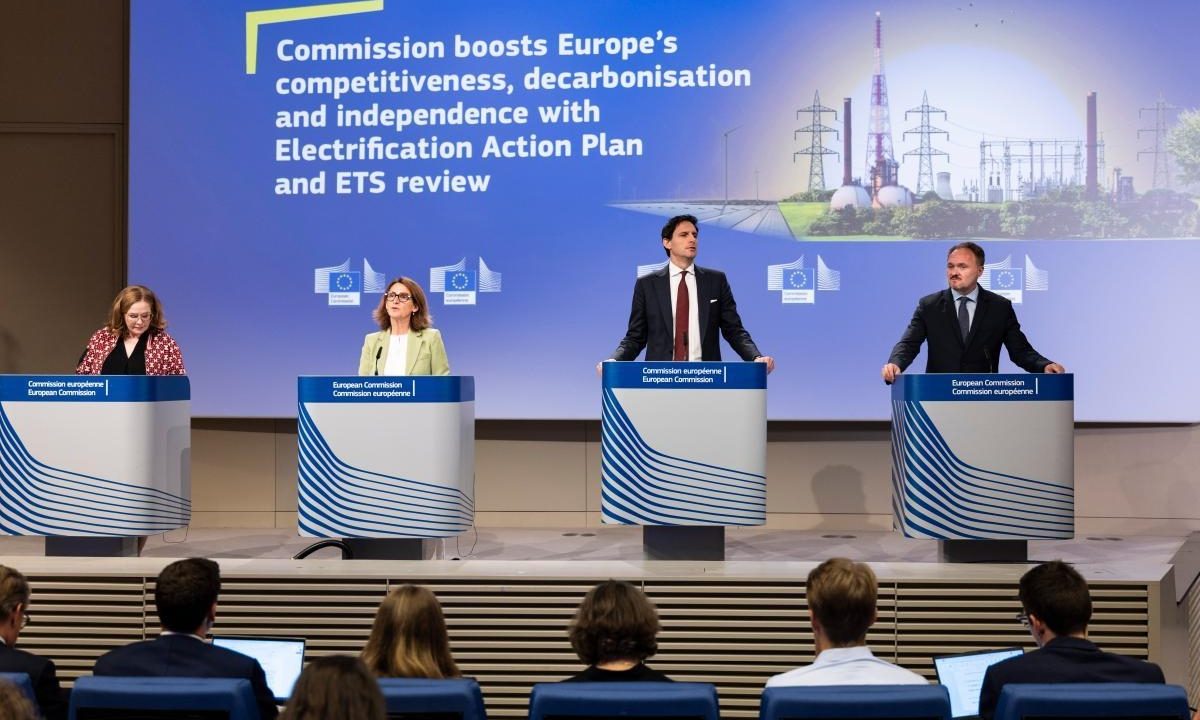
The European Commission has introduced a new EU ETS Reform Plan alongside an Electrification Action Plan, aiming to balance climate ambitions with the economic challenges facing European industries. The twin proposals seek to support businesses through the energy transition while keeping the European Union on track toward its long-term climate targets.
The emissions trading system (ETS), the EU’s primary carbon pricing mechanism, will undergo significant changes under the proposal. The Commission said the reforms are designed to reduce pressure on energy-intensive industries while maintaining progress toward the bloc’s legally binding target of cutting net greenhouse gas emissions by 90 percent by 2040 and reaching net-zero emissions by 2050.
One of the main changes is a slower pace of emissions reductions. The proposal lowers the Linear Reduction Factor (LRF) from 4.4 percent to 3.7 percent beginning in 2031, before reducing it further to 1.7 percent from 2036. The adjustment is intended to provide companies with additional time to adapt to stricter climate requirements.
The Commission also proposed extending free emissions allowances under the Carbon Border Adjustment Mechanism (CBAM) until 2038, delaying their planned phase-out. Companies that continue receiving support will be required to submit investment plans demonstrating progress toward cleaner production methods. Businesses leading in zero-emission technologies may also qualify for exemptions under the revised framework.
Supporters of the proposal said the reforms strike a balance between environmental goals and industrial competitiveness. Peter Liese, the European Parliament’s lead negotiator on the ETS, said the changes would help protect jobs while supporting long-term climate neutrality. He noted that sectors such as steel and chemicals require realistic timelines to complete their transition to lower-carbon production.
However, some climate policy experts expressed concern that the revised system could weaken incentives for companies already investing in cleaner technologies. Mats Engström, Senior Policy Fellow at the European Council on Foreign Relations, argued that easing emissions requirements could slow industrial decarbonization if not paired with stronger international cooperation.
Engström called for a broader international strategy focused on industrial transformation, including cooperation on infrastructure, financing, intellectual property, workforce development, and global climate policies. He also encouraged European environment ministers to strengthen cooperation through a coordinated “Team Europe” approach during upcoming policy discussions.
Alongside the ETS reforms, the Commission unveiled its Electrification Action Plan, which aims to increase the use of electricity across homes, businesses, and industry. Electricity currently accounts for roughly one-quarter of final energy consumption in the European Union, and the new plan seeks to raise that share by expanding access to clean power.
The strategy includes investments in electricity grids, faster deployment of renewable energy, and measures designed to make clean technologies more affordable. Proposed initiatives include social leasing programs for electric vehicles, heat pumps, and other energy-efficient technologies, helping households reduce energy costs while supporting cleaner transportation and heating.
Members of the European Parliament’s Socialists and Democrats Group welcomed the electrification plan. Officials said lower electricity prices, improved energy infrastructure, and broader access to clean technologies could strengthen Europe’s competitiveness while reducing dependence on fossil fuels.
The Commission also plans to review network charges and electricity pricing structures to encourage investment in clean energy while lowering costs for households, small businesses, and industry.
The proposals now move to the European Parliament and EU Council for negotiations before becoming law. The final outcome will determine how the EU ETS Reform Plan and Electrification Action Plan shape Europe’s transition toward a lower-carbon economy while supporting industrial growth, energy security, and long-term economic competitiveness.

