

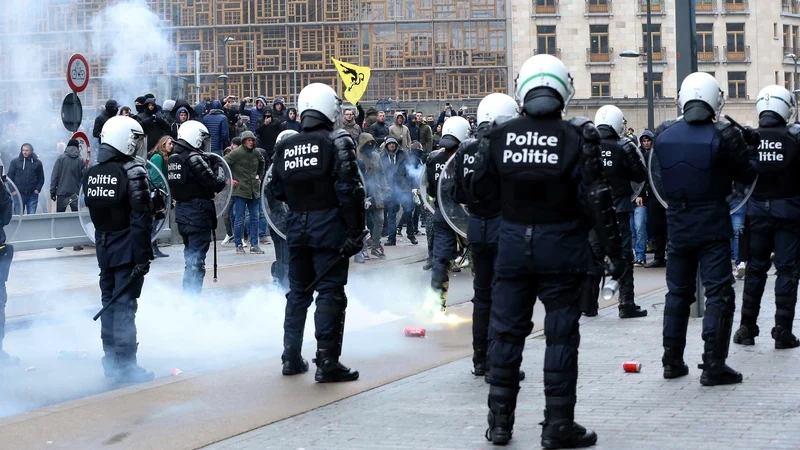
A rally supporting stricter immigration policies took place in Brussels on July 15 after Belgium’s highest administrative court overturned a local ban just hours before the event was scheduled to begin. The demonstration was held outside the European Parliament under heightened police security.
Supporters gathered at Place du Luxembourg, where a stage displayed a large banner reading “Remigration.” Police officers were deployed throughout the area to monitor the gathering and maintain public order as participants arrived.
The protest was organized by the Save Europe Act campaign, a group that is calling for tougher European Union immigration policies. Organizers say they want an EU-wide pause on immigration from outside Europe, quicker deportation procedures for people without legal permission to remain, and a voluntary remigration framework. The campaign also said it has collected more than 500,000 signatures in support of its proposals.
Among the speakers was Austrian activist Martin Sellner, who addressed supporters after the court ruling allowed the event to proceed. He described the decision as a victory for the organizers. Dutch political commentator Eva Vlaardingerbroek, who helped launch the campaign with Sellner on May 31, also spoke during the rally.
Former Belgian lawmaker Dries Van Langenhove also addressed participants. Van Langenhove, who previously served as a member of the Vlaams Belang party, has been convicted under Belgium’s anti-racism law. He appeared at the event alongside copies of the campaign petition signed by supporters.
The rally also attracted counter-demonstrators. Groups identifying themselves as anti-fascist gathered near the European Parliament to protest against the event and express opposition to the campaign’s immigration proposals.
Some employees working in the European Parliament also expressed concern about the demonstration. One staff member said the event made her feel uncomfortable because of the views promoted by some participants.
The rally had initially been prohibited by the mayor of Ixelles, Romain De Reusme, on July 14. The municipality includes Place du Luxembourg, where the gathering was planned.
The mayor said the decision was based on concerns about public safety following disorder during an earlier demonstration in Leuven organized by the Nationalistische Studentenvereniging, a nationalist student organization connected to the event.
However, Belgium’s Council of State reviewed the decision and canceled the ban shortly after midday on July 15. The court ruled before the scheduled start of the rally, allowing organizers to move forward with their plans.
Following the ruling, Mayor De Reusme criticized the decision and said he was disappointed by the outcome. He argued that the court’s timing left the local government without enough time to consider issuing another restriction before the demonstration began.
The legal decision follows a similar ruling issued in 2024. In that earlier case, a Belgian court found that the rights to freedom of expression and peaceful assembly had been violated when police shut down the National Conservatism Conference.
The latest case has again highlighted the balance between public safety concerns and the protection of fundamental rights such as free speech and peaceful assembly. Belgian courts have repeatedly emphasized that restrictions on public gatherings must meet legal standards and be supported by sufficient justification.
The campaign’s proposals have also received attention from European Union institutions. The European Commission informed the Save Europe Act campaign that its initiative appears to conflict with the Charter of Fundamental Rights of the European Union. According to the Commission, a general suspension of immigration based on national or ethnic origin could violate EU anti-discrimination principles.
Despite those concerns, organizers proceeded with the rally after the court ruling restored their right to hold the event. The demonstration ended under police supervision, while debate over immigration policy, freedom of assembly, and the legal limits of public demonstrations is expected to continue across Belgium and the European Union.

