

Belgium is facing growing wildfire concerns as hotter and increasingly variable summers combine with dry vegetation, raising questions about whether climate change is beginning to reshape the country’s traditionally limited wildfire season.
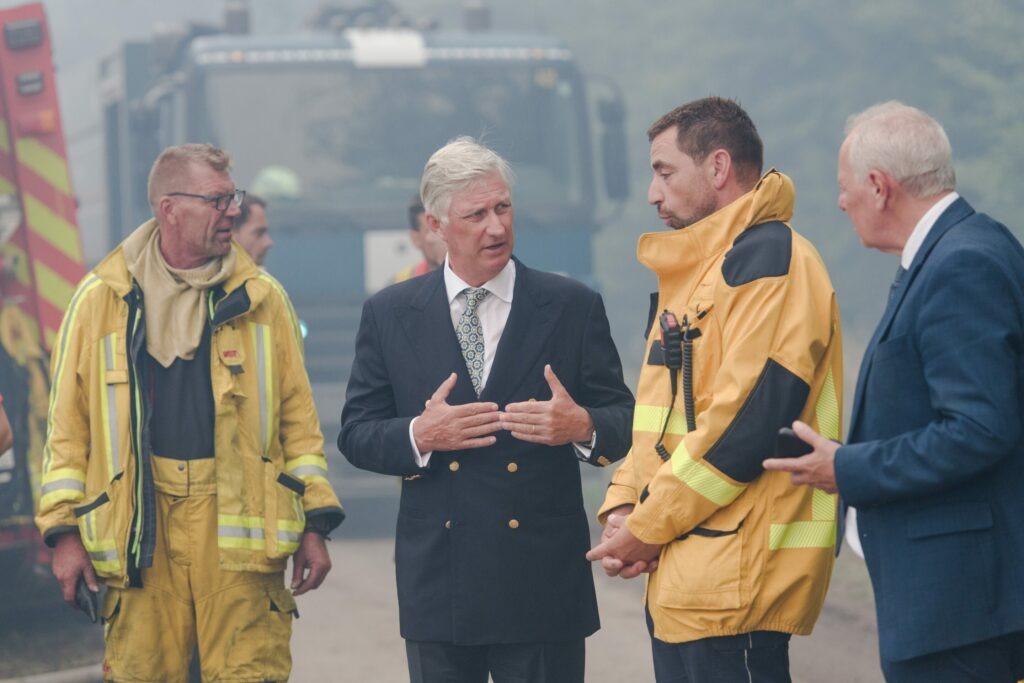
A major fire in the High Fens has already become one of Belgium’s largest wildfires on record. The blaze has burned about 3,000 hectares since Friday and required evacuations and assistance from firefighters, the army, farmers and international teams. King Philippe also visited the affected area as emergency crews worked to contain the fire.
The incident comes after Belgium recorded an unusually high number of wildfires this year. Research led by Jan Baetens, a wildfire expert at Ghent University, found that 234 wildfires had been recorded by August 13. That is more than twice the 115 fires recorded in 2025 and about 3.8 times the long-term annual average of 62 between 2010 and 2025.
The figures do not include the High Fens fire.
Baetens said about 95% of wildfires are started by people, whether through accidents, carelessness or deliberate actions. However, weather conditions determine whether an ignition develops into a larger wildfire.
Belgium has historically experienced its main wildfire peak during spring. This year, the pattern has shifted significantly. About 180 of the 234 recorded fires, or 77%, occurred during the meteorological summer.
Researchers caution that the figures should be interpreted carefully. Of the 117 additional fires added to the database after July 29, roughly half had actually occurred before July 28 but were only confirmed and recorded later.
Even with that limitation, researchers say the changing weather pattern is significant.
Nicolas Ghilain, a climatologist at Belgium’s Royal Meteorological Institute and the University of Liège, said the country’s average annual temperature has increased by about 2.5°C since the pre-industrial period.
Belgium has not experienced a clear long-term decline in annual rainfall. Instead, Ghilain said the timing of rainfall is changing. Spring, already relatively dry, is becoming drier on average, while summers are showing greater differences between exceptionally wet and exceptionally dry years.
Those conditions can increase wildfire danger. Extended periods of heat and limited rainfall reduce moisture in soil and vegetation, allowing fires to spread more easily.
Baetens said extreme meteorological conditions were contributing to the unusually high number of fires this year. He pointed to longer periods of drought and high temperatures, combined with low humidity, as factors that can make vegetation more vulnerable to ignition and rapid fire spread.
Ghilain, however, urged caution when linking a specific wildfire directly to climate change. He said individual events require formal attribution studies to determine whether global warming made them more likely. The RMI has not yet completed such an assessment of the recent heat and drought.
Nevertheless, he said global warming is creating conditions that are increasingly favourable to extreme events. Higher temperatures increase evaporation and plant water loss, causing soils and vegetation to dry faster.
The growing number of summer fires has also raised concerns that Belgium could eventually develop a wildfire pattern more commonly associated with southern Europe. Baetens said that if Belgium’s climate increasingly resembles southern regions, its wildfire regime could also become more similar.
The geographical distribution of fires has changed as well. Flanders accounted for 57% of recorded fires this year, while Wallonia represented 43%. Historically, the division has been closer to 80% in Flanders and 20% in Wallonia.
Limburg recorded the largest provincial share at 26%, followed by Namur at 15%. West Flanders and Luxembourg each accounted for 12%, while Liège and Antwerp recorded 9% each.
Belgium is already examining how its future climate could affect wildfire risks. Researchers are using three climate models to project conditions through 2100, including drought and extreme rainfall. Ghilain said Belgium could be around 4°C warmer than the pre-industrial period by the end of the century, while extreme temperatures could rise even further.
Emergency services are also preparing. Specialist wildfire training is available in provinces including Liège and Luxembourg, and Belgian firefighters have travelled to France for additional training.
Philippe Filleul, an emergency services commander in Walloon Brabant, said more personnel still need specialist wildfire training. He also noted that Belgium has off-road firefighting vehicles designed for vegetation fires, although equipment varies according to local risks.
The High Fens presents additional difficulties because peat can continue burning underground even after surface flames disappear. Rain can help contain the spread, but underground fires may persist.
Belgium also lacks a dedicated fleet of firefighting helicopters or water-bombing aircraft. Federal police helicopters can be equipped to drop water, but officials say aircraft such as Canadair amphibious planes may need consideration if wildfire risks continue increasing.
For emergency services, the challenge is becoming clear: Belgium may need broader training, stronger equipment and greater aerial capacity if hotter and drier conditions make major wildfires increasingly common.

