

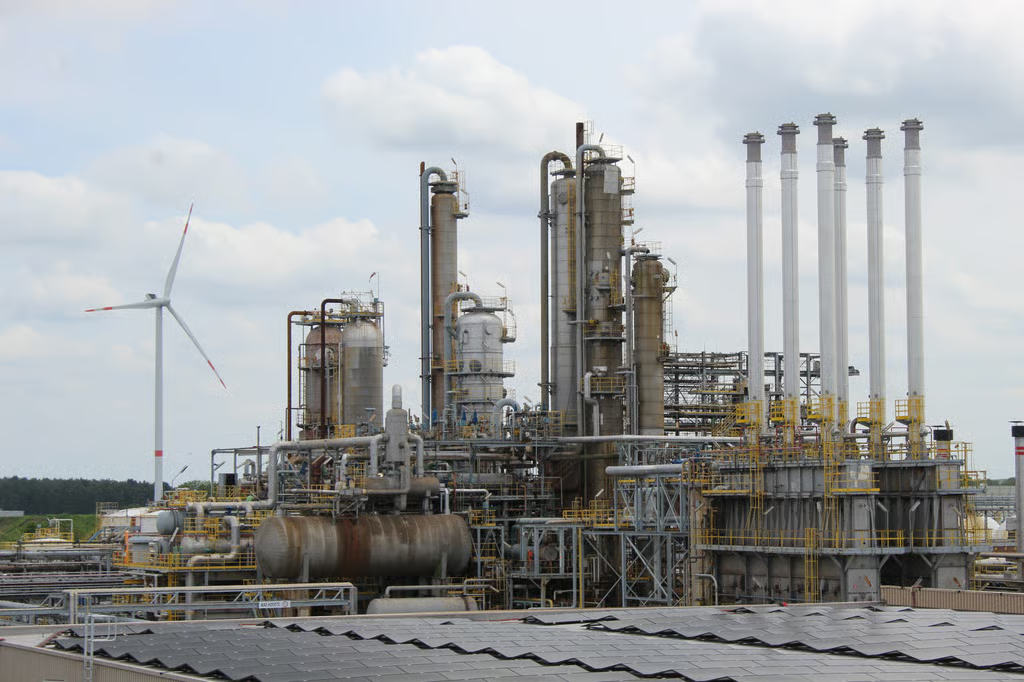
The EU chemicals industry crisis is pushing European policymakers toward urgent intervention as a surge of low-cost imports from China places significant pressure on domestic manufacturers across the bloc.
The European Commission is now preparing possible measures aimed at stabilising the sector, which industry leaders say is facing severe financial strain due to global overcapacity and rising import competition. EU leaders are expected to discuss the issue at a summit later this month.
Industry representatives warn that the situation is becoming critical. Some companies say production sites are being shut down or placed under restructuring as margins collapse under pressure from cheaper foreign supply.
One of the most affected materials is polyvinyl chloride, or PVC, widely used in construction, medical equipment, and electrical products. European producers say they are being undercut by Chinese competitors who have rapidly expanded output in recent years.
The EU chemicals industry crisis has been described by some executives as an existential threat, with concerns that delays in policy action could lead to further closures before protective measures are implemented.
According to industry data, Europe’s chemical production capacity has declined significantly in recent years, with thousands of jobs lost as companies scale back operations or close plants entirely. At the same time, reliance on imported chemicals has steadily increased.
China has emerged as the largest external supplier to the EU chemical market, with its share of imports doubling over the past decade. Analysts say this reflects massive expansion in Chinese petrochemical production, driven initially by domestic demand and later by excess capacity.
European producers argue that high energy costs are a major disadvantage. Electricity prices in Europe are significantly higher than in competing regions, increasing production costs for energy-intensive processes used in chemical manufacturing.
The EU chemicals industry crisis is further intensified by carbon pricing under the Emissions Trading System, which adds additional costs for European producers. Industry groups say these costs are not faced equally by competitors outside the bloc.
The European Commission is examining a range of possible responses. These include import quotas, targeted tariffs, and broader trade defence tools designed to limit the impact of global overcapacity.
Officials are also considering mechanisms similar to those used in the steel sector, where safeguards were introduced to limit imports and stabilise domestic production. However, applying similar measures to chemicals is more complex due to the wide range of products involved.
Unlike steel, the chemicals sector includes thousands of different products across multiple supply chains, making it difficult to design uniform trade restrictions without unintended consequences for downstream industries.
Some policymakers argue that stronger trade defence tools are necessary to protect strategic industrial capacity within Europe. They warn that excessive dependence on external suppliers could create vulnerabilities in critical sectors such as manufacturing, energy, and defence.
At the same time, not all industry players support broad restrictions. Some multinational chemical companies with global operations argue that overcapacity is a worldwide issue and caution against measures that could restrict trade too aggressively.
They suggest that targeted action, rather than blanket trade barriers, may be a more balanced approach to addressing unfair competition while maintaining global supply chain stability.
The debate highlights a growing tension within European industrial policy between open trade principles and the need to protect domestic production from structural global imbalances.
Experts say that anti-dumping investigations and existing trade defence tools are often too slow to respond to rapidly changing market conditions, especially in capital-intensive sectors like chemicals.
Industry representatives warn that time is running out. They argue that even if new measures are introduced, delays in implementation could mean further closures and job losses before relief reaches manufacturers.
As discussions continue in Brussels, the EU chemicals industry crisis remains a key test of Europe’s ability to respond to global industrial competition while balancing economic openness with strategic resilience.

