

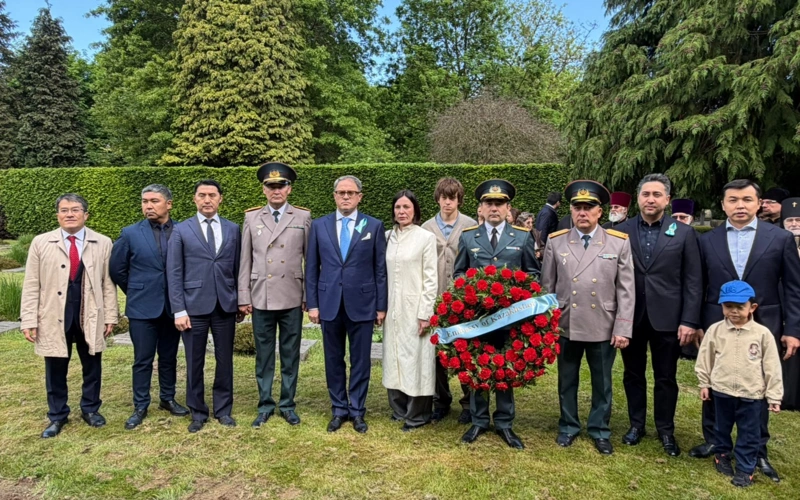
The Brussels Victory Day memorial ceremony was held at a historic cemetery in Belgium, where wreaths were laid to honor fallen heroes of World War II. The event marked a solemn tribute to those who lost their lives during the war, including Soviet citizens buried in Belgium. Diplomats and military representatives attended the ceremony to pay their respects.
The wreath-laying was conducted on behalf of Kazakhstan by Roman Vassilenko, the country’s Ambassador to Belgium and Luxembourg, who also serves as Head of Mission to the European Union and NATO. He was joined by Kazakhstan’s Military Attaché to the Benelux countries and Military Representative to NATO. The delegation honored the memory of those who died in the liberation struggle.
The ceremony took place at the Brussels municipal cemetery in the commune of Evere. This site contains mass graves from World War II, including burial areas for Soviet citizens. The cemetery includes a fenced section with small headstones that display names, birth dates, and death dates of the fallen. It serves as an important historical site for remembrance.
In 1999, a memorial was installed at the cemetery to honor Soviet citizens who died in Belgium during the war. The monument consists of a stone slab placed on a low concrete base. It bears inscriptions in Russian, French, and Dutch. The text reads: “To the Soviet citizens who fell for the liberation of Belgium.” The memorial has since become a central point for annual remembrance events.
Every year on Victory Day, a wreath-laying ceremony is held at the site. The event brings together diplomats, military officers, and administrative staff from various countries. Representatives from Commonwealth of Independent States (CIS) nations regularly attend to honor shared historical memory and wartime sacrifices.
The ceremony reflects a broader tradition of remembrance across Europe and beyond. Victory Day commemorates the end of World War II in Europe and honors those who fought against fascism. In many countries, it is marked by memorial services, wreath-laying events, and moments of silence.
The Brussels ceremony is part of ongoing efforts to preserve historical memory and strengthen diplomatic ties through shared remembrance. Officials emphasized the importance of honoring those who died during the war, regardless of nationality. The event highlights how historical events continue to shape modern diplomatic relations.
Earlier reports also noted similar commemorations in Kazakhstan. Senior political leaders, including the Prime Minister, Senate Speaker, and Majilis Speaker, paid tribute to fallen heroes at the Otan Ana Monument in Astana. These parallel ceremonies show how Victory Day is observed across different countries.
The Brussels memorial remains a significant symbol of wartime history and international cooperation. It stands as a reminder of the human cost of conflict and the importance of remembering those who sacrificed their lives during World War II.
As wreaths were laid and tributes were paid, the ceremony in Evere reinforced a message of respect, remembrance, and shared historical responsibility among participating nations.

