

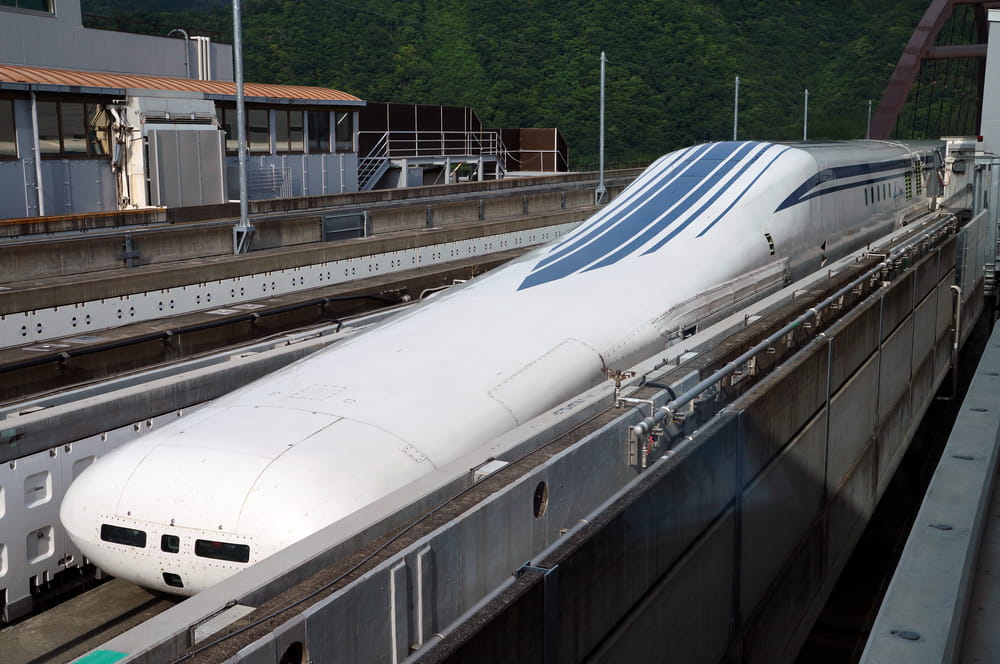
Japan is developing the L0 Series, a magnetic-levitation (maglev) train expected to reach speeds of up to 603.5 km/h, making it the fastest train ever built. The project is led by Central Japan Railway Company and will run on the new Chūō Shinkansen line.
At full operation, the train is expected to cut travel time between Tokyo and Nagoya to about 40 minutes, with a future extension to Osaka reducing the Tokyo–Osaka journey to roughly one hour. By comparison, Europe’s fastest conventional trains — such as France’s TGV or Italy’s Italo — operate at around 300–350 km/h.
The extreme speed comes from maglev technology, which lifts the train above the track using magnetic forces, eliminating wheel-rail friction. However, this also makes the system expensive and complex. The project has already cost about £52bn (€60bn) and has been delayed, with an expected opening now pushed to 2034–35.
Could it work in Europe?
Experts say it would be difficult. The L0 Series requires entirely new, dedicated infrastructure, much of it in tunnels, and cannot run on existing European rail lines. It is also energy-intensive, carries fewer passengers than many European high-speed trains, and would struggle to justify its costs outside dense, business-focused corridors.
In addition, European rail travel often prioritises comfort, accessibility and scenic journeys over extreme speed, except on routes such as London–Paris or London–Brussels. While the technology is impressive, the consensus is that Europe is unlikely to adopt trains like the L0 Series anytime soon.

