

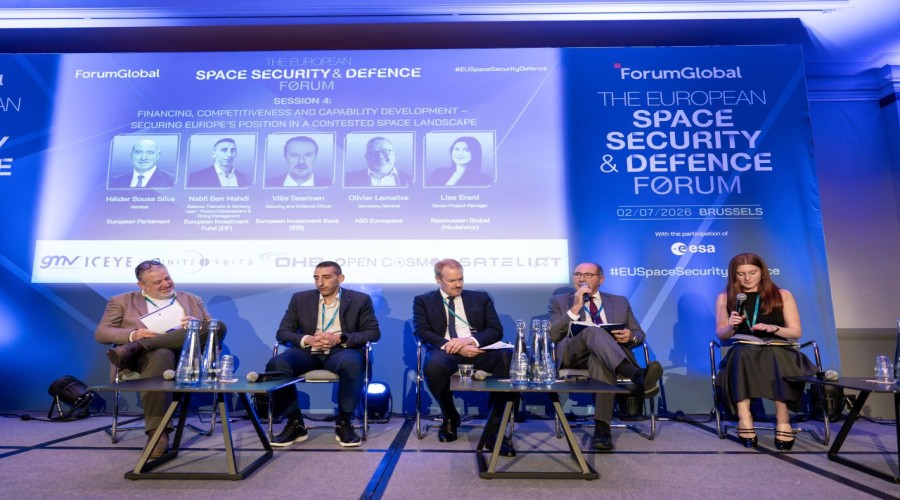
The European Space Security & Defence Forum has concluded in Brussels after bringing together senior officials, military leaders, financial experts, and industry representatives to discuss the future of Europe’s space security and defence capabilities. The one-day event focused on strengthening Europe’s position in an increasingly competitive and contested space environment.
Participants examined how Europe can improve cooperation between its space and defence sectors while increasing investment in new technologies and critical infrastructure. The discussions also explored ways to strengthen Europe’s strategic independence and maintain its competitiveness in the global space industry.
The forum attracted policymakers, military leadership, financial institutions, and companies working in the space and defence sectors. Together, they discussed the growing link between space systems and national security, as well as the challenges created by rapid technological change and rising international competition.
A major speech during the event was delivered by General Sean Clancy, Chair of the European Union Military Committee. He spoke about the changing security environment and explained why space has become an increasingly important part of Europe’s defence strategy.
Clancy said modern defence operations now depend heavily on space-based technologies. These include satellite communications, navigation systems, intelligence gathering, and Earth observation. Protecting these capabilities has become a growing priority for European governments and defence organizations.
The forum also included a panel discussion on financing, industrial growth, and capability development. Experts examined how Europe can better coordinate investment in space technologies while supporting innovation and expanding its industrial base.
The discussion brought together representatives from the European Parliament, the European Investment Fund, the European Investment Bank, and the European space industry. Speakers agreed that long-term investment will play a key role in maintaining Europe’s technological leadership and building a more resilient space sector.
Panel members stressed that closer cooperation between governments, financial institutions, and private companies will be necessary to support research, infrastructure, and advanced space technologies. They also highlighted the importance of creating competitive European companies that can succeed in the global market.
The event ended with a keynote address by Colonel Sylvain Debarre, Director at the NATO Space Centre of Excellence. He emphasized the growing importance of international cooperation in protecting space assets and ensuring that allied nations can continue to operate effectively in space.
Debarre said space has become an essential part of modern defence planning. He noted that satellites support military communications, navigation, disaster response, and many civilian services that countries rely on every day. Protecting these systems has become increasingly important as more nations develop advanced space capabilities.
Organizers said the forum welcomed more than 150 delegates from across Europe. The program featured 23 expert panelists, five discussion panels, and nine keynote speeches, reflecting strong interest in the future of European space security and defence cooperation.
The event received support from several organizations involved in space technology, defence, cybersecurity, and satellite development. Their participation highlighted the growing partnership between public institutions and private industry in advancing Europe’s space ambitions.
Space has become a strategic priority for many governments because satellites support communication, navigation, weather forecasting, emergency response, scientific research, and national security. As more countries invest in space technology, protecting these systems has become an important part of long-term defence planning.
The forum concluded with a shared message that Europe must continue investing in innovation, strengthen cooperation among allies, and better connect its space, defence, and industrial strategies. Participants agreed that these efforts will help improve Europe’s resilience, enhance security, and support its long-term competitiveness in the rapidly evolving global space sector.

