

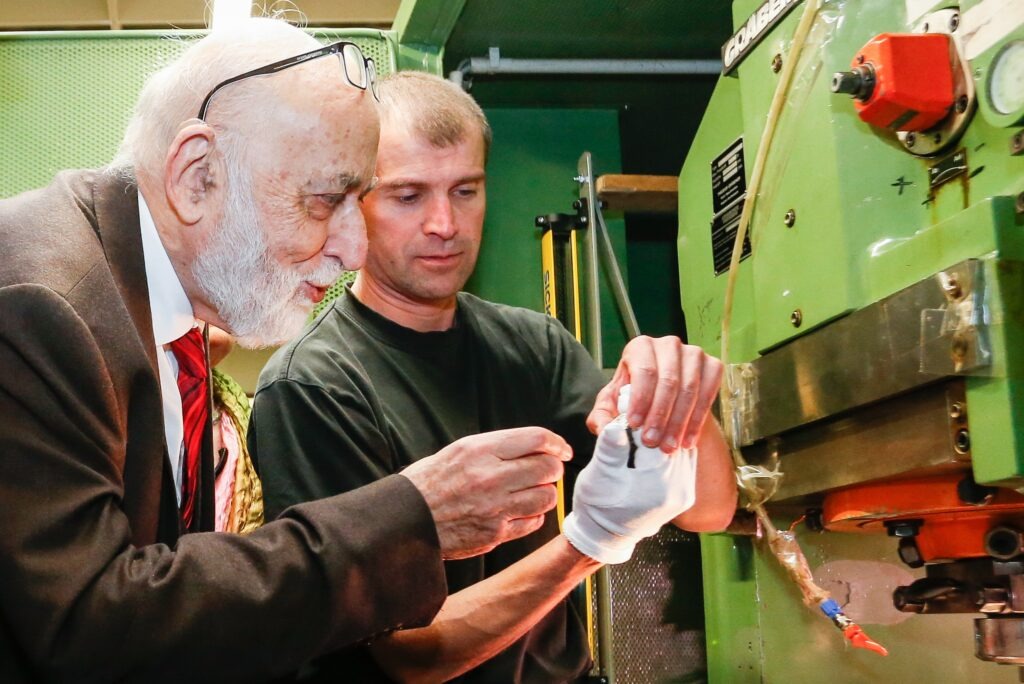
Belgian physicist François Englert, who helped explain how basic particles gain mass, has died at the age of 93. Englert died on June 18, according to the information provided.
His work changed modern physics and helped answer one of its biggest questions. It also led to the discovery of the particle later known as the Higgs boson.
Englert was born in Brussels in 1932. He studied and later worked at the Université Libre de Bruxelles, where he spent much of his career.
In 1964, Englert and his American colleague Robert Brout developed a new theory about the way particles gain mass.
At the time, scientists did not fully understand why some basic particles had mass while others did not. Englert and Brout proposed that particles gain mass by interacting with a field that fills the universe.
This field became known as the Higgs field. The idea was that particles moving through the field would interact with it. That interaction would give them mass.
The theory was a major step in the study of particle physics. Without the process described by the theory, the basic structure of matter would not exist as we know it.
British physicist Peter Higgs published a similar idea only weeks later. The particle linked to the field later became known as the Higgs boson.
The particle was also given the popular name “God particle”. Englert did not favor that term. He preferred the scientific name scalar boson.
When Englert and Brout developed their theory in the 1960s, there was no way to test it directly. The technology needed to find the predicted particle did not yet exist.
Still, Englert believed the theory would eventually be confirmed. He later recalled that he and Brout felt confident enough to celebrate after completing their work.
They went to a cafe near the university and shared a bottle of champagne.
It took almost five decades for scientists to find direct evidence of the particle. In 2012, researchers at CERN announced that they had observed a new particle that matched the expected features of the Higgs boson.
The discovery was made using the Large Hadron Collider, a 27-kilometre particle accelerator near the Swiss-French border.
The machine allows scientists to collide protons at very high energy. These collisions can create short-lived particles that help researchers study the basic parts of matter.
The 2012 discovery gave strong support to the theory developed by Englert and Brout in 1964.
Brout had died in 2011. Englert and Higgs later shared the 2013 Nobel Prize in Physics for their work on the mechanism that helps particles gain mass.
The award brought major attention to Englert in Belgium. Later that year, King Albert II made him a baron.
Englert’s early life was also marked by the Second World War. He was born to Polish Jewish parents and survived the Nazi occupation by hiding in rural Wallonia.
As a child, he helped local resistance fighters. At about 10 years old, he secretly counted German train carriages. The information was used to help resistance efforts.
After the war, Englert returned to Brussels. He studied at the Université Libre de Bruxelles before moving from applied physics toward the study of quantum physics.
His working style was unusual. He kept a second-hand mattress in his university office and said that lying down helped him think and develop new ideas.
He also had a strong interest in classical music. He believed music, including Mozart, could sometimes offer a deeper view of scientific ideas than a formal lecture.
Despite the long wait for the Nobel Prize, Englert did not regret that recognition came late in his life. He once joked that receiving the prize at 50 could have created problems for his research.
Englert leaves behind a major scientific legacy. His work helped explain one of the basic features of the universe and played a key role in one of the most important discoveries in modern particle physics.

