

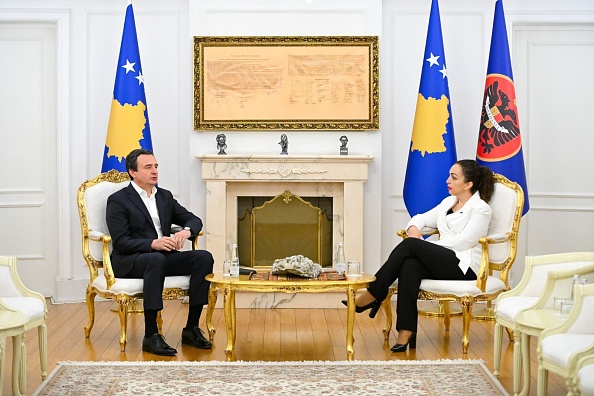
Kosovo is heading into a new round of voting on Sunday as the Kosovo election crisis continues to deepen, raising concerns in Brussels about the country’s political stability and its long-term path toward European Union integration. This will be the third parliamentary election in just over a year, reflecting a prolonged institutional deadlock.
For much of the past 18 months, Kosovo has struggled with a weakening political system and incomplete governance structures. The repeated elections have left key institutions only partly functional, slowing decision-making and delaying reforms needed for EU progress.
Much of the political tension has centered on Prime Minister Albin Kurti, whose nationalist-led government has faced criticism from both domestic opponents and international partners. Critics argue that his approach has limited political compromise and worsened relations with key allies.
EU officials have repeatedly stressed that Kosovo must strengthen its institutions and improve dialogue with Serbia. European Council President António Costa recently visited Pristina and highlighted that the EU has invested €3.7 billion in Kosovo since 1999. He said strong and stable institutions are essential for Kosovo’s European future.
The Kosovo election crisis has become closely linked to the country’s stalled normalisation process with Serbia. Kurti has maintained a firm stance toward Belgrade, making it a central part of his political platform. However, this position has created friction with both EU and US officials who are pushing for renewed dialogue.
In his remarks, Costa said the European Union can support Kosovo but cannot replace domestic political responsibility. He emphasized that progress depends on internal compromise and functioning democratic institutions.
The political crisis escalated in March when parliament failed to elect a new president. The breakdown followed the collapse of a political alignment between President Vjosa Osmani and Kurti’s caretaker government.
The dispute reportedly emerged over differences in foreign policy priorities. Osmani was seen as more aligned with strengthening ties with Brussels and Washington, while Kurti was viewed as taking a more independent and nationalist approach.
Kurti’s Vetëvendosje party refused to support Osmani’s re-election, despite earlier cooperation. At the same time, opposition parties including the Democratic Party of Kosovo and the Democratic League of Kosovo also withheld support, creating a parliamentary deadlock.
As the Kosovo election crisis worsened, attempts to break the impasse failed. Multiple votes were boycotted by opposition parties, preventing parliament from reaching the required quorum to make decisions.
Osmani later called for snap elections, warning that political instability was being driven by what she described as irresponsible leadership decisions. However, the Constitutional Court ruled that her move to dissolve parliament was not legal and gave lawmakers additional time to resolve the situation.
Despite this extension, no agreement was reached, leading to the current election cycle. Kurti’s party is still expected to win the largest share of votes, with polling suggesting support above 40 percent. However, this would still fall short of the majority needed to fully resolve the presidential and governance deadlock.
The Kosovo election crisis is further complicated by tensions involving the country’s ethnic Serb minority. The community holds guaranteed parliamentary seats but has often been at odds with ethnic Albanian political leadership.
Kurti’s government has taken steps to integrate Serbian-run institutions into Kosovo’s system, including education and healthcare services. Supporters say this is part of strengthening state authority, while critics argue it undermines previously agreed arrangements supported by the EU.
European officials have warned that such actions must be handled carefully and in consultation with minority communities. They stress that Kosovo’s constitutional framework was designed to ensure minority rights and encourage compromise between groups.
Relations with Serbia remain one of the most sensitive issues in Kosovo’s political landscape. Kurti has refused to engage in high-level EU-led talks under certain conditions, further slowing progress in negotiations.
The European Union has recently lifted some earlier punitive measures imposed on Kosovo but continues to link financial support and growth funding to progress on reforms and political stability. Delays in governance reforms have placed millions in EU-backed development funds at risk.
While opinion polls in Kosovo can be inconsistent, Kurti remains a leading political figure heading into the election. However, EU officials continue to emphasize that what Kosovo needs most is stable governance capable of compromise and long-term decision-making.
As voters head to the polls, the outcome is expected to shape not only domestic politics but also Kosovo’s relationship with the European Union and its broader international standing.

